Your first British CV
How do you write your first CV with no work experience?
Write a first British CV using real education, projects and skills. Follow a clear structure, with fictional examples to help you find your own words.

Build your first CV around your education and real examples of skills from projects, placements or volunteering. You do not need paid work to have something relevant to describe.1
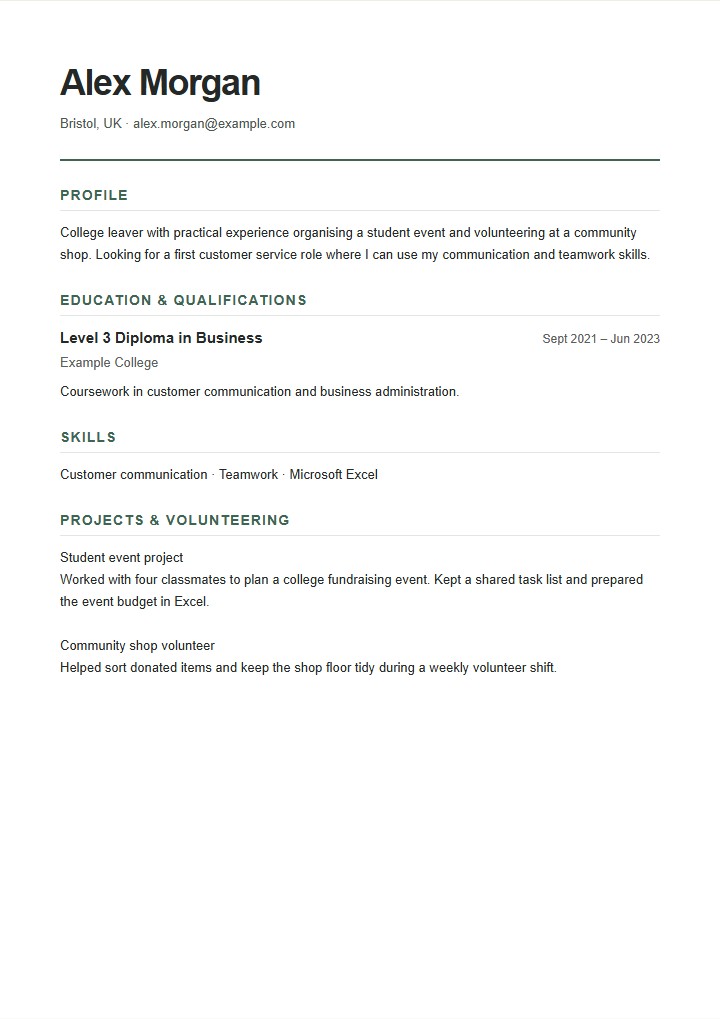
Read the example as text
Fictional example of a first CV.
Alex Morgan
Bristol, UK · alex.morgan@example.com
Profile
College leaver with practical experience organising a student event and volunteering at a community shop. Looking for a first customer service role where I can use my communication and teamwork skills.
Education
Level 3 Diploma in Business
Example College
Sep 2021 – Jun 2023
Coursework in customer communication and business administration.
Skills
Customer communication · Teamwork · Microsoft Excel
Projects & volunteering
Student event project
Worked with four classmates to plan a college fundraising event. Kept a shared task list and prepared the event budget in Excel.
Community shop volunteer
Helped sort donated items and keep the shop floor tidy during a weekly volunteer shift.
What a first CV needs to show
A CV introduces the experience and skills you bring to a job application. This guide focuses on a first British CV, rather than a US résumé or an academic CV.
The National Careers Service recommends using relevant projects, work experience, volunteering and interests when your work history is short. It also recommends matching your content to the vacancy.1
Start with a blank note headed 'Things I have actually done'. Add tasks from study, clubs, practical projects or helping with an event. Keep the wording rough for now. Choose experiences you could explain if an interviewer asked what your contribution was.
A useful first-CV example names the task and your contribution, rather than listing a skill without context.
Use a structure you can fill honestly
For an early-career CV, the National Careers Service suggests putting education after the introduction. Include qualifications, where you studied and attendance dates.1
Careers Wales includes contact details, a profile, skills, education and volunteering in its CV guidance.2 Use the following structure as a starting template. Leave out empty sections.
- Contact details: use your name, phone number and email. The National Careers Service advises leaving out age, date of birth, marital status and nationality.1
- Profile: write a short introduction connecting your current situation to the role you want.
- Education: add your actual course or qualification details. Distinguish a qualification you are studying for from one you have already completed.
- Experience and projects: describe relevant placements, volunteering or projects, using clear labels for each.
- Skills: include abilities you can demonstrate. Pair broad claims such as teamwork with a specific example elsewhere in the CV.
Find the evidence behind a skill
The National Careers Service recommends STAR for describing experience: situation, task, action and result. You can use it to prepare examples for a CV as well as an interview.3
As a writing exercise, note the situation first. Then separate what the group did from what you personally did. Finish with what happened or what you learned. The CV version can be shorter than your working notes.
These examples are fictional. They show how to move from an activity to a specific statement. Copy the approach only when you have a comparable, genuine experience.
A result can describe what you completed or learned. Add a number only when it is true and you can support it.
| Activity | Skill to explain | Example wording |
|---|---|---|
| Group coursework | Organisation | Set up a shared task list and checked the group's slides before our presentation. |
| Community event volunteering | Communication | Welcomed visitors, answered questions about the programme and directed them to the right room. |
| A personal spreadsheet project | Spreadsheet skills | Built a household spending sheet and used formulas to compare planned and actual costs. |
Write a profile that sounds like you
Try drafting your profile after the other sections. Read your examples and choose the ones that relate most closely to the role. Avoid a string of adjectives you would struggle to explain.
This fictional profile assumes the applicant really has the stated volunteering experience. Use it as a shape for your own introduction, not as experience to borrow.
Fictional exampleSchool leaver looking for a customer service role. Through volunteering at a community event, I have welcomed visitors and answered questions about activities. I would like to bring that experience to a role helping customers in person.
Make a version for the actual vacancy
Careers Wales recommends tailoring each CV to the vacancy.2 Try this editing exercise: place the advert beside your draft and match its requirements to genuine examples. Treat a requirement you do not meet as a gap. Do not change the meaning of your experience.
For a fictional shop vacancy asking for customer communication, the event-volunteering example could be useful. For a role involving spreadsheets, the personal project might deserve more space. The same person can emphasise different genuine experience.
- Highlight the tasks and skills in the vacancy. Make a short working list.
- Match each relevant requirement to something you have done. Keep your original notes nearby.
- Rewrite vague phrases with concrete actions. Remove claims you cannot explain.
- Read the draft as if you were asked about each example at an interview. Correct anything that overstates your role.
Check the CV and prepare the application
If you offer references, the National Careers Service advises keeping the referee's contact details off the CV. Get the person's agreement first.1
For a cover letter, the National Careers Service recommends explaining your interest in the employer and supporting relevant claims with facts. Keep a copy of the letter for interview preparation.4
In the editor, select the UK format and use the education-first option if it suits your draft. Projects and volunteering have their own optional field. Preview the document, check the contact details and read every line aloud before exporting.
Use Download PDF for the exported file and check it for awkward page breaks and missing text. In the connected service, a download without a watermark uses one credit; Print preview includes a watermark. Follow the employer's application instructions, then keep a record of the version you sent and any response.
Sources
- National Careers Service: How to write a CV First-job experience, education, tailoring, contact details and references. Checked 18 September 2026.
- Careers Wales: Build a CV CV sections and tailoring to a vacancy. Checked 18 September 2026.
- National Careers Service: The STAR method Using specific experiences to explain your contribution and the result. Checked 18 September 2026.
- National Careers Service: How to write a cover letter Supporting claims with facts and keeping a copy. Checked 18 September 2026.
Sources checked on 18 September 2026. Follow the current instructions that apply to your circumstances.